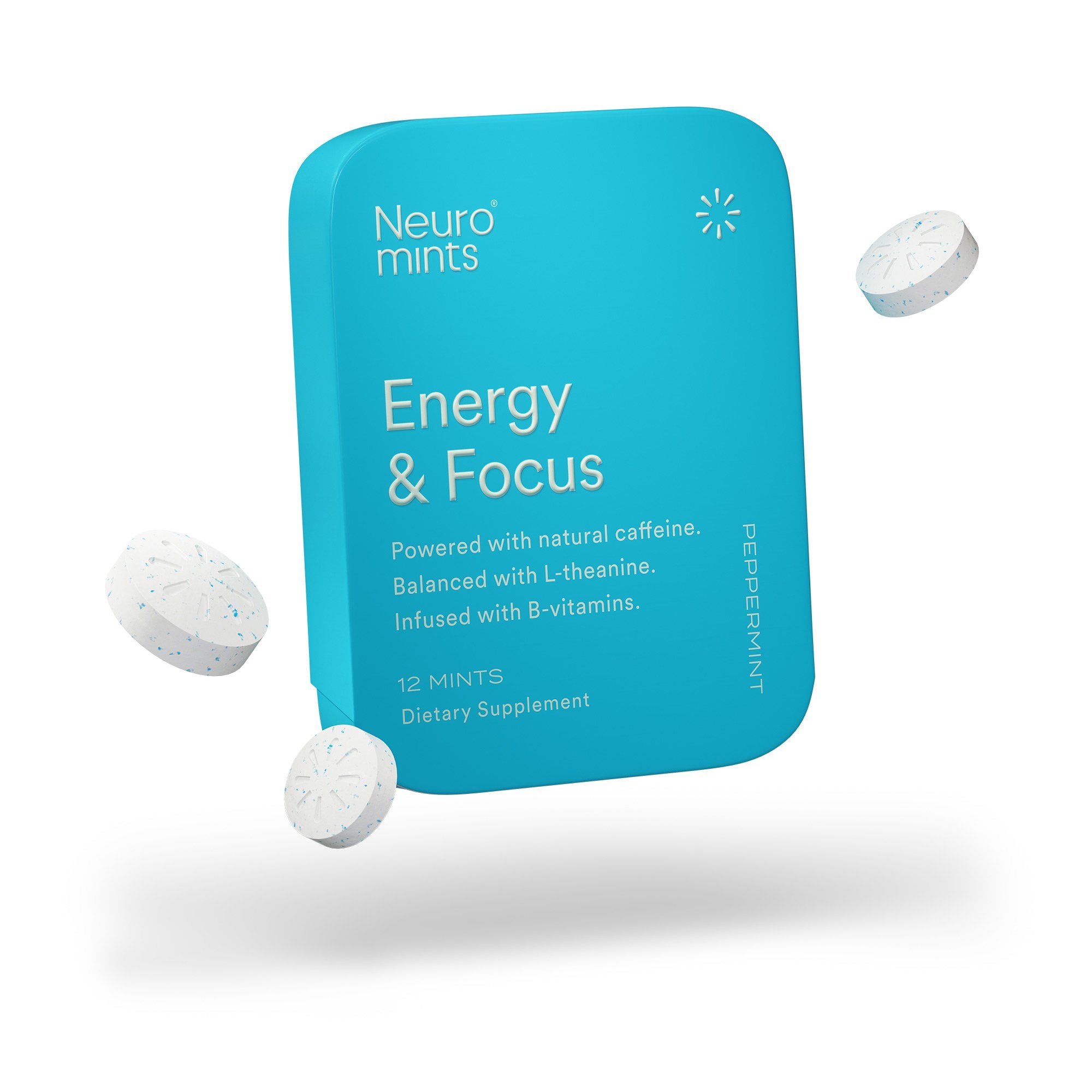
You've seen them. Those little hexagonal tins tucked away near the checkout counter or popping up in your social feed. They promise a "clean" buzz. No jitters. No crash. Just pure, unadulterated brainpower. But honestly, most of us are skeptical. Is neuro mints energy and focus just a glorified breath mint with a caffeine kick, or is there actually some biochemical wizardry going on under the hood?
Let’s get real.
Most energy products are essentially liquid heart palpitations in a can. You drink them, your heart starts racing like a hummingbird, and ninety minutes later, you’re staring at your laptop screen feeling like a deflated balloon. Neuro Gum (the company behind the mints) claims to solve this through something called buccal absorption. Basically, the good stuff enters your system through the tissues in your mouth rather than waiting for your stomach to process it. It sounds fancy. It’s actually just how medicine has worked for decades, but applied to your afternoon slump.
The Chemistry of Neuro Mints Energy and Focus
When you pop one of these mints, you aren’t just getting caffeine. If it were just caffeine, you’d be better off buying a bottle of 200mg pills for five bucks. The secret—if you can call it that—is the ratio.
Each mint contains about 40mg of caffeine. For context, a standard cup of coffee is around 95mg. But the "focus" part comes from the addition of L-theanine and B-vitamins.
Why the L-Theanine Matters
Ever wonder why green tea feels different than a double espresso? It’s the L-theanine. This amino acid is a vasodilator. It relaxes you without making you sleepy. When you pair it with caffeine, it sort of "rounds off" the sharp edges of the stimulant. You get the alertness without the "I might accidentally vibrate out of my chair" feeling. Research published in journals like Biological Psychology has shown that this specific combination improves multitasking performance and reduces susceptibility to distractions. It’s not magic; it’s just better engineering.
The Vitamin B Component
The mints also pack B6 and B12. Now, let’s be clear: vitamins won't give you a "rush." Anyone telling you that B-vitamins are a stimulant is lying. What they do do is facilitate energy metabolism. They help your body actually use the fuel you've already got. If you’re already B-vitamin deficient—which, let's face it, many of us are—you might notice a more significant "lift." If your levels are optimal, these are basically just an insurance policy.
The Absorption Argument: Mouth vs. Stomach
Here is where it gets interesting.
When you drink a coffee, it has to go through your entire digestive tract. It hits the stomach, goes to the small intestine, gets processed by the liver, and then enters the bloodstream. This takes anywhere from 20 to 45 minutes.
With neuro mints energy and focus, the delivery is different. Because you're chewing and holding the mint in your mouth, the ingredients are absorbed through the oral mucosa. This bypasses the "first-pass metabolism" of the liver. The result? You usually feel it in about 5 to 10 minutes.
It’s fast.
I’ve used these during long drives where the "heavy eye" syndrome starts to kick in. You don't want to wait 45 minutes for a Starbucks to kick in when you're doing 70 mph on the interstate. You need it now. That's the primary use case here. It’s convenience and speed over volume.
Does it actually taste like a mint?
Honestly? Sorta.
If you’re expecting an Altoid, you’ll be disappointed. There is a slight medicinal bitterness if you park the mint in one spot for too long. That’s the caffeine. Caffeine is naturally bitter. The peppermint or cinnamon flavor does a decent job of masking it, but it’s definitely a "functional" mint. You aren't eating these because you want a treat; you're eating them because you have a deadline at 4:00 PM and your brain feels like wet bread.
The texture is also worth noting. It’s a bit firmer than a standard mint. It’s designed to be chewed and held, maximizing that contact time with your cheeks and under your tongue.
The Cost of Convenience
Let’s talk money. Because this is usually where people get hung up.
A pack of Neuro Mints is going to cost you more per milligram of caffeine than almost any other source. You are paying for the formulation and the form factor.
- Coffee: ~$0.05 per mg of caffeine (brewed at home)
- Caffeine Pills: ~$0.01 per mg
- Neuro Mints: ~$0.15 to $0.20 per mg
If you’re just looking for the cheapest way to stay awake, this isn't it. But if you value not having to pee every thirty minutes (looking at you, cold brew) or you need something that fits in a pocket during a hike or a high-stakes meeting, the math changes.
Real-World Limitations and the "Crash" Myth
Is there a crash?
Generally, no. But that’s mostly because the dose is relatively low. 40mg of caffeine is a "microdose" by modern standards. If you’re used to drinking Bang energy drinks or three-shot lattes, you might not feel much of anything from one mint. You might need two or three.
And here’s the reality: no supplement can replace sleep.
We try to hack our way around exhaustion with neuro mints energy and focus, but if you’re running on four hours of sleep, your adenosine receptors are already flooded. Caffeine works by blocking those receptors. If the "sleepiness" molecules are already locked in, the caffeine has nowhere to go. It’s like trying to park a car in a lot that’s already full.
You also have to consider your own caffeine sensitivity. Some people are "fast metabolizers" (thanks to the CYP1A2 gene), and others are "slow." If you’re a slow metabolizer, even a 40mg mint at 3:00 PM might mess with your sleep at 11:00 PM.
Comparison: Mints vs. Gum
Neuro makes both. The ingredients are identical. The choice really comes down to your social environment and how you like to consume things.
The gum lasts longer. You can chew it for twenty minutes, ensuring every last bit of the active ingredients gets absorbed. However, chewing gum in a professional setting or a quiet library can be... annoying. The mints are discrete. They dissolve. You’re done.
I personally prefer the mints for the "quick hit" aspect. The gum can get a bit rubbery after the initial flavor burst, which is a common complaint among long-time users.
Who is this actually for?
It’s not for the gym rat. If you’re trying to hit a new PR on deadlifts, go get a high-stim pre-workout.
This is for:
- The Student: Pulling a late night but needing to stay "level" rather than jittery.
- The Professional: Someone who needs a mental reset before a presentation but doesn't want coffee breath or a stained shirt.
- The Traveler: Avoiding the "airplane fog" without having to rely on terrible terminal coffee.
- The Athlete: Cyclists or runners who need a quick sugar-free boost without the slosh of liquid in their stomach.
Better Ways to Use Them
Don't just pop them like candy. To get the most out of the "focus" side of the equation, use them tactically.
Wait until you feel that first dip in mental clarity. For most people, that’s about 2:00 PM. Instead of reaching for a sugary snack or another soda, try one mint. Give it ten minutes. Notice how your focus shifts. It should feel like a subtle sharpening of the edges, not a kick in the chest.
Also, pay attention to hydration. Caffeine is a mild diuretic, and even in small doses, being slightly dehydrated will counteract any "focus" benefits you get from the mint. Drink a glass of water with it.
Final Verdict on Neuro Mints Energy and Focus
Are they a miracle? No. They are a tool.
The combination of L-theanine and caffeine is backed by legitimate science. The buccal absorption method is a real thing. The convenience is undeniable.
If you expect to feel like you’re on the "Limitless" pill, you’ll be disappointed. But if you’re looking for a controlled, portable way to manage your energy levels without the chaos of traditional energy drinks, they are arguably one of the best options on the market.
Next Steps for Better Focus:
- Check your baseline: If you're already consuming 400mg of caffeine a day, these mints won't do much. Try a caffeine reset for 3 days before introducing them.
- Time your intake: Use the "90-minute rule." Avoid caffeine for the first 90 minutes after waking up to let your natural cortisol do its job. Pop a Neuro Mint once that natural peak starts to fade.
- Trial the flavor: Start with the Peppermint. It tends to mask the caffeine bitterness better than the Cinnamon for most people.
- Observe the "Theanine Effect": Notice if you feel less "wired" than you do with coffee. If you do, that L-theanine is doing its job.